Bun vs Node.js: The Runtime That Changes Everything in 2026

Node.js has run the server-side JavaScript world for fifteen years. It powers everything from startups to Fortune 500 backends. Then in 2023, Bun arrived — built from scratch in Zig, running on JavaScriptCore instead of V8, and shipped as a single binary that replaces your runtime, package manager, bundler, and test runner all at once. In 2026, the question isn't whether Bun is fast. It demonstrably is. The question is: when does that actually matter for you?
Head-to-Head Comparison
| Feature | Node.js | Bun |
|---|---|---|
| Engine | V8 (Chrome) | JavaScriptCore (Safari) |
| Language | C++ + libuv | Zig + io_uring |
| HTTP Throughput | ~14,000 req/sec | ~52,000 req/sec (~3.7×) |
| Cold Start | 40–120ms | 8–15ms (10× faster) |
| Package Install | npm ~18s / pnpm ~12s | ~2s (6–9× faster) |
| TypeScript Support | Via ts-node / build step | Native (zero config) |
| Built-in Bundler | No (needs webpack/esbuild) | Yes |
| Built-in Test Runner | Via Jest / Vitest | Yes |
| npm Compatibility | 100% | ~95% (native addons break) |
| Ecosystem Maturity | 15 years, battle-tested | 3 years, maturing fast |
| Memory (Next.js app) | ~512MB baseline | ~380MB baseline (−26%) |
| Windows Support | Excellent | Good (Bun 1.2, Jan 2025) |
| Best For | Existing codebases, enterprise | New projects, serverless, CLIs |
Under the Hood — Why Bun Is Different
Node.js — Built on Chrome's V8
Node.js uses V8, Google Chrome's JavaScript engine, paired with libuv for async I/O. V8 is an engineering masterpiece — optimized for long-running processes, its JIT compiler gets better the longer your server runs. But it carries real overhead: a layered I/O abstraction, a C++ codebase accumulated over a decade, and a startup cost that reflects all of that.
Bun — Built on Safari's JavaScriptCore, Written in Zig
Bun runs on JavaScriptCore — WebKit's engine, the same one powering Safari. JSC is engineered to start fast, not just run fast. Then Bun's own runtime, written in Zig, talks directly to the OS via io_uring, bypassing the libuv abstraction layer entirely. Zero-copy I/O. Reused buffers. A tighter request lifecycle from the ground up. This isn't a patch on Node. It's a different architecture.
The Core Difference
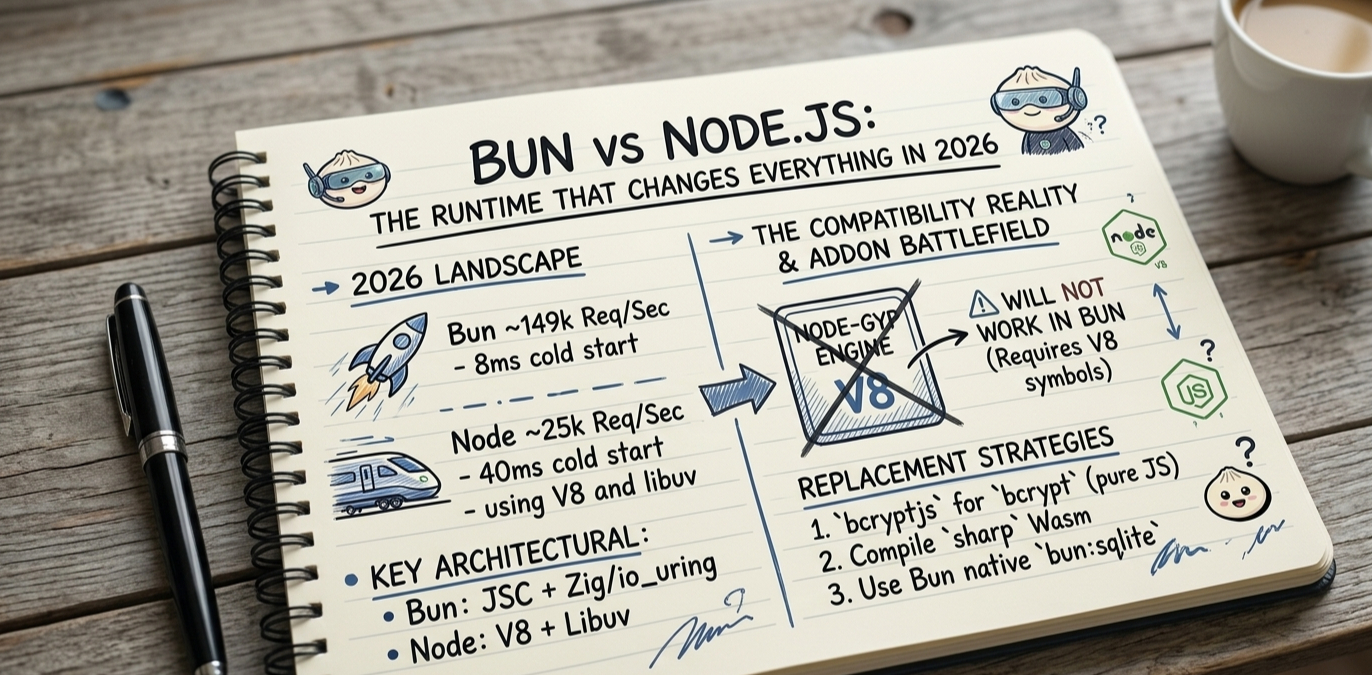
V8 optimizes for long-running processes. JavaScriptCore optimizes for fast startup. This single architectural decision explains most of the benchmark results below.
Advantages
Raw Performance
HTTP Throughput (raw server, no framework)
Benchmark: Hello World JSON response, M2 MacBook Pro. Results vary by hardware and workload.
Package Install Speed (React app with dependencies)
Cold Start
8–15ms
Bun
40–120ms
Node.js
Critical for serverless, CLI tools, and Lambda cold starts
TypeScript Execution
~50ms
bun run
~1,200ms
ts-node
100-file TypeScript project. Bun transpiles natively — no tsc, no ts-node, no build step.
Winner: Bun — by a significant margin
3.7× HTTP throughput, 10× faster cold starts, 25× faster package installs. But for database-bound apps, where 90% of latency is in the query, runtimes benchmark within 1ms of each other. Know your actual bottleneck.
The Toolchain — One Binary to Rule Them
Jarred Sumner, Bun's creator, put it plainly: "We did not build Bun to replace Node.js. We built it to replace the 15 tools you need alongside Node.js." That's the real pitch — not raw speed, but radical simplification.
Node.js Stack (typical)
Bun Stack
Getting started — the difference is immediate
# Node.js (new TypeScript project)
npm init -y
npm install typescript ts-node @types/node nodemon jest
npx tsc --init
# ...configure tsconfig, jest.config, nodemon.json
node_modules/.bin/nodemon --exec ts-node src/index.ts

# Bun (same project)
bun init
bun run src/index.ts  # TypeScript. Just runs.
The Compatibility Reality
Bun markets itself as a "drop-in Node.js replacement." That's mostly true in 2026 — and the gap matters for the remaining mostly. Here's the honest picture.
npm Compatibility in 2026
~95% of packages work without any modification
Express, Fastify, Hono, Prisma, Drizzle, Zod, tRPC — all work
fs, path, buffer, http, stream — all Node core APIs supported
The 5% That Can Block You
Native addons (node-gyp)
Packages with compiled C++ bindings (e.g., bcrypt, some DB drivers) link against V8/libuv. Bun uses JavaScriptCore — they won't work without recompilation. Use bcryptjs instead of bcrypt as a common workaround.
Complex Worker Threads patterns
Basic usage works. SharedArrayBuffer with Atomics.waitAsync and large ArrayBuffer transfers across workers have partial or degraded support.
node:cluster edge cases
Bun 1.2 (January 2025) improved cluster module compatibility significantly — but some edge cases remain. Test before deploying multi-process Node apps.
Quick audit before migrating
# Check for native addon dependencies
grep -r "node-gyp\|binding.gyp\|nan\|node-addon-api" node_modules/.bin

# List packages with native bindings
npm ls --all 2>/dev/null | grep -i "native\|binding\|addon"
If this returns nothing, your migration is likely smooth. If it returns hits — evaluate those packages first.
Ecosystem & Adoption in 2026
Bun Weekly Downloads Growth
Source: PkgPulse, Q1 2026 data
Adoption Leaders
- ✓CLI tools — widespread
- ✓New TypeScript services
- ✓Serverless / edge functions
- ✓CI/CD pipelines (install speed)
Staying on Node.js
- →Large existing codebases
- →Enterprise with native addons
- →Teams with mature Node infra
- →DB-bound apps (latency tied to query)
Running Both
- →Bun for dev + CI
- →Node.js for production server
- →Pragmatic, increasingly common
- →bun install cuts pipeline time anyway
The Inflection Point
Bun's 85% YoY growth wasn't driven by HTTP benchmarks — it came when GitHub Actions and CircleCI added native Bun caching in late 2025. bun install in CI dropped install times dramatically, pulling in developers who'd never cared about runtime speed.
When to Use Each
Stay with Node.js If:
- ✓You have an existing production codebase — don't migrate for the sake of benchmarks
- ✓Your dependencies include native addons (node-gyp, bcrypt, sharp with C bindings)
- ✓Your team's bottleneck is database latency, not runtime throughput
- ✓You need enterprise LTS guarantees and maximum ecosystem compatibility
- ✓You're deploying complex Worker Threads or multi-process cluster architectures
Choose Bun If:
- ✓Starting a new TypeScript project from zero — the DX alone is worth it
- ✓Building CLI tools or scripts where cold start and startup speed matter
- ✓Deploying serverless functions or edge compute (AWS Lambda, Cloudflare Workers)
- ✓Building high-traffic APIs where throughput is a primary concern
- ✓You're tired of maintaining separate npm, tsc, jest, and bundler configs
Key Takeaway
Node.js isn't going anywhere. Fifteen years of ecosystem depth, universal compatibility, and battle-tested production reliability don't disappear because a faster runtime exists. It's the safe, correct choice for existing systems.
Bun wins on new projects. 3.7× throughput, 10× faster cold starts, zero-config TypeScript, and a single binary replacing six tools. For greenfield TypeScript work in 2026, the case for Node.js is harder to make.
The toolchain story is the real headline. Raw HTTP speed matters at scale. But bun install finishing in 2 seconds instead of 18 changes your daily rhythm — regardless of what runs in production.
Audit your native addons first. The 5% incompatibility is real, and it bites at the worst time. Run a dependency audit before migrating any existing Node project to Bun.
You don't have to choose. Many teams run Bun for local dev and CI (instant installs, native TypeScript) and deploy to Node.js in production. That's a legitimate 2026 strategy — and it's worth the install speed alone.
Ready to Try Bun?
The lowest-risk first step
# Install Bun
curl -fsSL https://bun.sh/install | bash

# Use it as your package manager — zero migration risk
bun install   # drops into your existing Node project
bun test      # replaces jest, same syntax

# When you're ready — run TypeScript natively
bun run src/index.ts
Start with bun install as a drop-in replacement for npm. No runtime changes, no compatibility risk. Just faster installs. Then decide if you want more.
Maintaining an existing system? Stay on Node.js — it's excellent and it'll be here in fifteen more years. Starting something new in 2026? Start with Bun — the performance is real, the DX is better, and the toolchain simplification alone will make your mornings quieter.
Keep reading.
More from Web Development
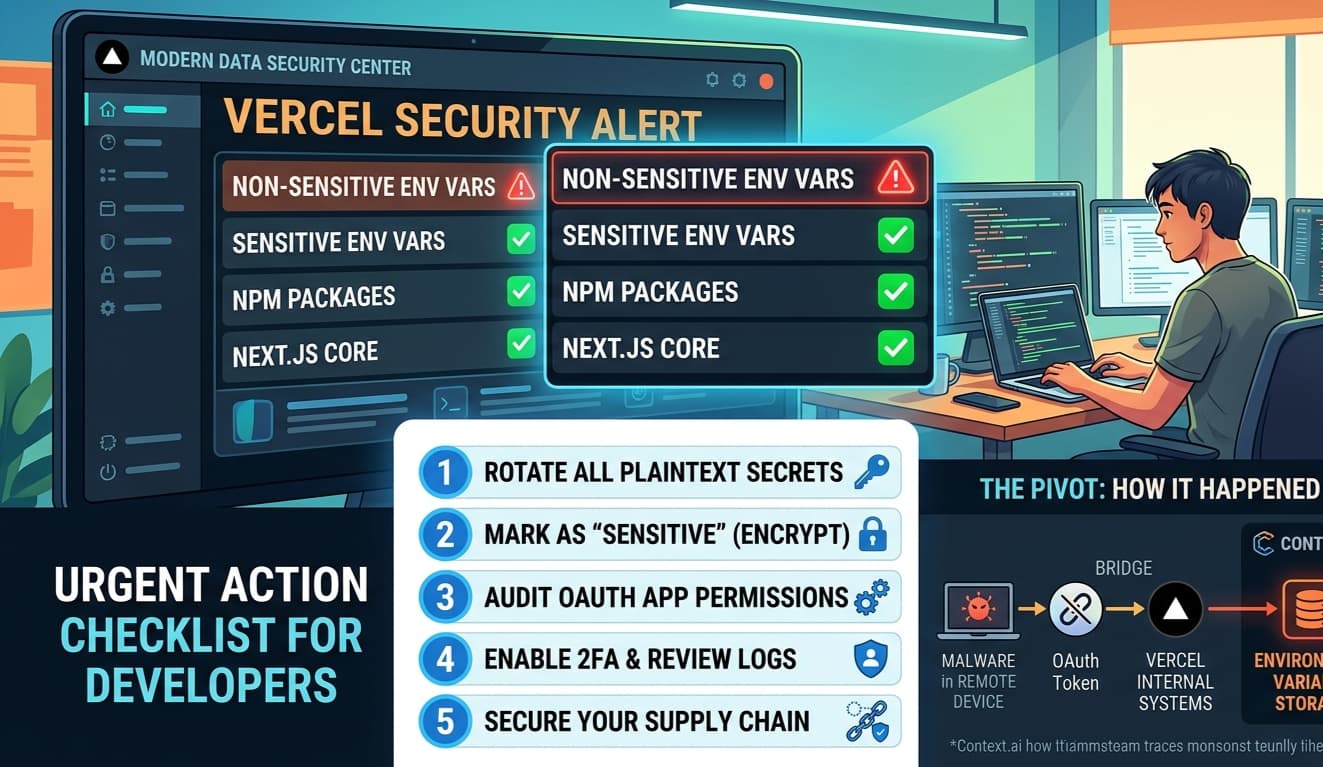
The Vercel Breach — What Every Next.js Developer Needs to Do Right Now
On April 19, 2026, Vercel confirmed a security breach. If you're a Next.js developer with projects on Vercel — and you almost certainly are — this direc...
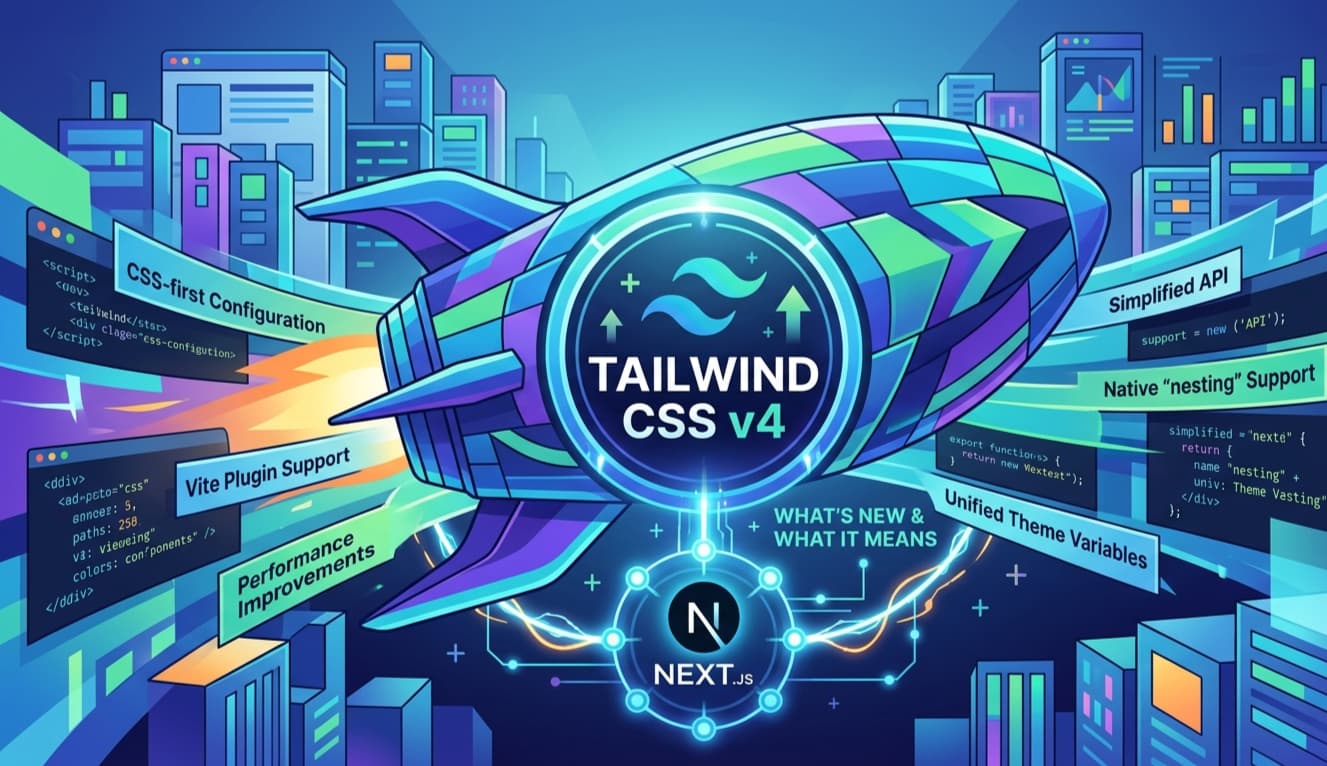
Tailwind CSS v4: What Actually Changed (And What It Means for Your Next.js Project)
Tailwind CSS v3 had a good run. Configure your theme in tailwind.config.js, point the content array at your files, done. Then Tailwind CSS v4 shipped in...
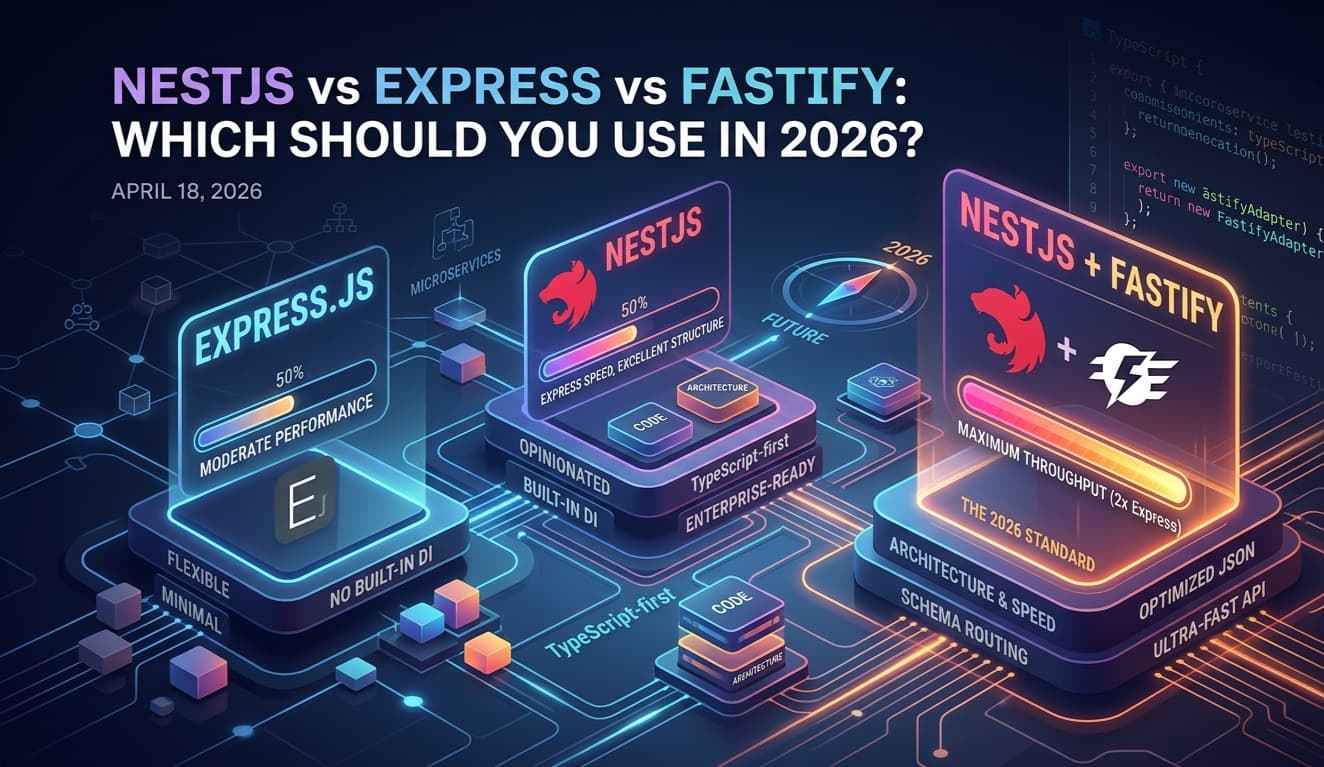
NestJS vs Express vs Fastify: Which Should You Use in 2026?
Express has been the default Node.js backend since 2010. NestJS brought structure and TypeScript to the chaos. But in 2026, there's a third dimension wo...